Saturday, November 23, 2013

Beyond the Walls of Rome: North Trip: Part 1

Over the course of our term in Rome, there are two major field trips that everyone looks forward to; the south trip for Rome and the Campagna and the north trip for Italian Urban History. Unlike the south field trip, where every day was fairly relaxing, with lectures during the day, and lounging on the beach in the afternoon and evening, the north trip was intense! The trip was full of switching cities and switching hotels, plus lots and lots of lectures. The lectures were all centered around the idea of the city as a theatre. A place for viewing, and a place to be viewed. During this trip, we also had to do a series of urban armature sketches, that showed the main armature or organizing principle of each city, from gate to gate.

First Stop: Pienza

Pienza was a small medieval town that was rebuilt and repopulated by one of the popes who was born there. The town is surrounded by nature on all sides, giving the people who live there these amazing views of the Tuscan countryside. In the centre of the town, there was a large piazza, with views opening on either side on the church towards the landscape. This square is also one of the brightest spaces in the city, drawing you from the one main road into the light that fills the space.

Urban Armature

The Outer Path of Pienza

The Back of The Piazza in Pienza

Against the Tuscan Landscape

Second Stop: Siena

Siena was the next beautiful town in the north that we visited. This was the second time I can here, having been once already with my family. (And yes, this is where the colour siena comes from, all the bricks in the city are that colour.) Siena was incredibly interesting because of the sqaure at the centre of the city. The square, called "Piazza del Campo" is a sloped piazza, sloping down toward the Palazzo (the cities former government building and current historical museum). This square has an history of horse racing, that continues to this day. Each year (possibly twice a year) each of the 17 districts of Siena choose a horse and rider to race one lap around the piazza. The winner gets bragging rights for a year until the next race is held. The Piazza has 11 entrances and exits that all point you in different directions out into the city. There is also an incredible church in the city called the Duomo, all clad in black and white marble stripes. It kind of looked like the Hamburgeler of churches, but I digress. Siena is a wonderful city that is definitely worth a visit (or two).

Siena Urban Armature

Siena from Above

The Duomo

The Palazzo

Third Stop: Gubbio

Gubbio was an odd third stop. After hours and hours spent on a bus because of torrential rain in Italy washing out part of the highway, we stopped in Gubbio for exactly 30 minutes just as the sun was about to set. Our prof lead the way as we rushed up a series of stairs to a hanging piazza, overlooking the landscape. The view was beautiful, the sky had cleared and the sunset was inspiring. I guess that's why Gubbio was worth a quick stop.

Gubbio Urban Armature

Sunset in Gubbio

Sunset in Gubbio

Fourth Stop: Urbino

Oh Urbino. What to say. Well, you couldn't go anywhere without going uphill. They somehow managed to build that town so that you are always walking uphill! I don't remember going downhill at any point. It was quite odd. The city is built on two peaks of a mini mountain with a main piazza in the valley (I guess I lied about going downhill, but the uphills took so much longer, and thus, get more emphasis).There is not a ton to say about Urbino. It seemed almost as though it was built as a Utopia. Nothing felt out of place there, and the city framed itself at every turn, creating these perfect viewing windows of different areas. No where did this better than the park at the top of one of the peaks. This park was the perfect place to sit and sketch, while appreciating the beauty of the townscape on the other peak. One other interesting thing about Urbino was our accommodation. We had our first ever University living experience! We stayed in dorms and ate cafeteria food. It was exactly as described. Small, cell-like, not exactly clean, and the food was pretty gross, but its cheapness made up for the taste.

Urbino Urban Armature

Urbino First Peak Piazza

View from the Park on the Second Peak

Urbino Through Framed Views

Urbino from the Park at Night

Fifth Stop: Parma

Parma was a city of frames. Frames of history, and literal frames made by the arches present in every single building. Parma, unfortunately, was one of the cities approved to be bombed by the allies in World War II. Luckily, much of the history of the city survived, including the Farnese Theatre. This was the first ever theatre to use a Proscenium. Part of the Palazzo that hosts this theatre was destroyed, but the area left open by it has become a beautiful park, through which people bike and walk to cross the city. The Duomo also survived the war, along with its piazza, forming a historical frame within the city.
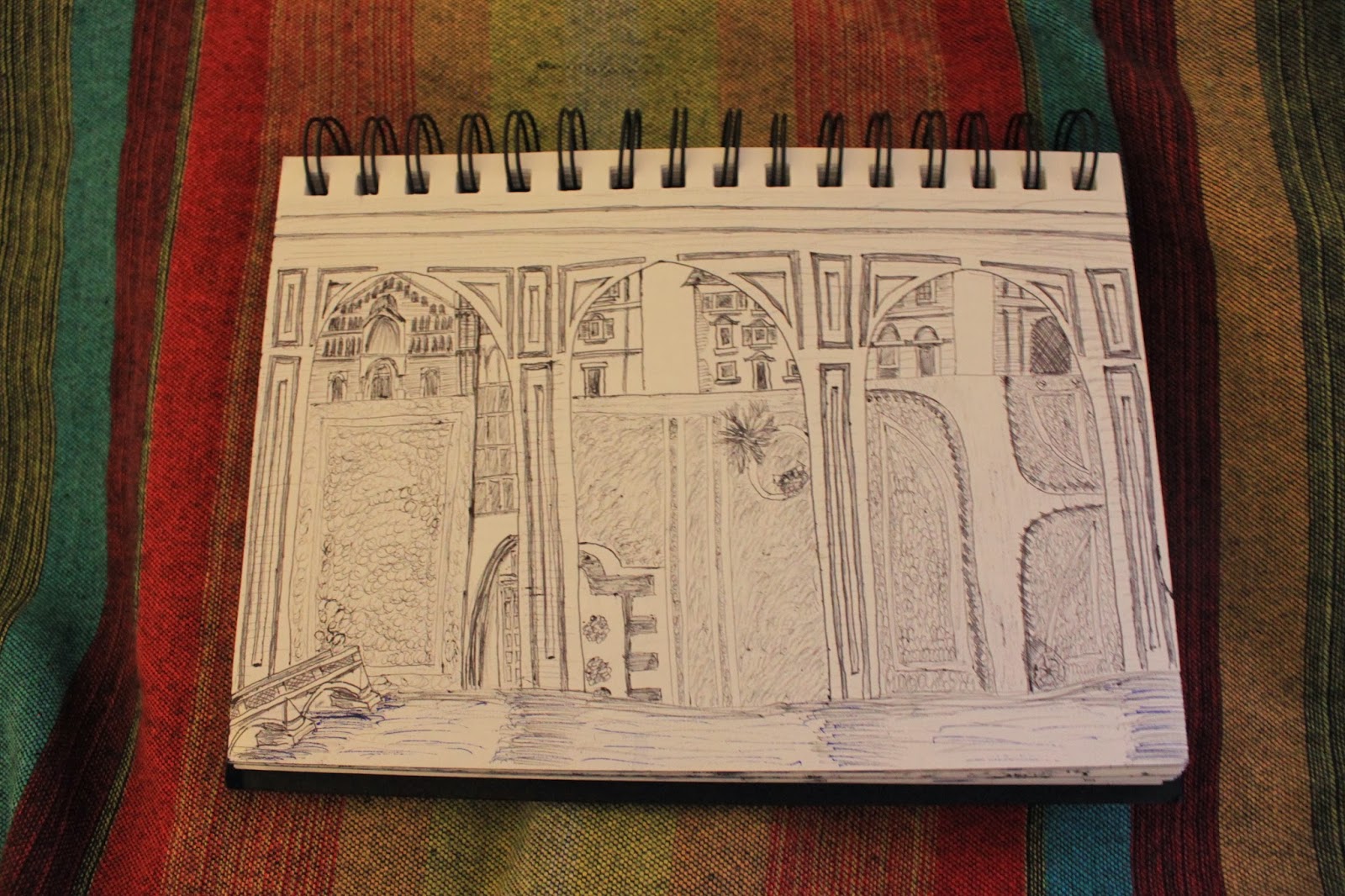
Parma Urban Armature


Parma Palazzo

Farnese Theatre

Crossing the River in Parma

A Church in Parma

Wow, this post has gotten long! I will do the other half of the trip in another post sometime soon.

Ciao for now!


Friday, November 22, 2013

October in Rome: Part 2

At the end of our brief but amazing course with Rick, we celebrated Thanksgiving as a class. What an undertaking! We ordered 5 large turkeys, and it fell to member of the class who had an oven to cook them (luckily, my roommates and I only have a stove, so we were saved this stress). Everyone else had to bring a side dish. We made mashed potatoes and quinoa salad, both of which were delicious and disappeared before seconds were served! Eating dinner with our whole class (all 60 of us) squeezed into our lecture hall was quite an experience! Nobody could get up unless everyone got up, and no one could sit down until everyone was ready to sit down. It was very amusing.

We also had some lovely entertainment at our dinner. Some of my classmates rediscovered some never before heard scenes from our 2011 play Ilion. At the time, one of the guys writing the play had this incredible dry sense of humor, and could turn any sentence into a punch line, simply with how he delivered it. Although he is no longer in our class, some of the other writers did their best to read the scenes he wrote with the same delivery with which they was intended. The whole spectacle brought back wonderful memories of acting in the play, and the camaraderie it brought us. Not to mention it was so funny, they couldn't even finish reading the scenes, because of the uncontrollable laughter echoing off the walls.

And then, it was time to focus on the next project before the class field trip to the north of Italy. Like the first project, this one was located in the Via dis Fiori Imperiale and Colosseum area of the city. We were tasked with designing a new master plan for the area which proved to be quite a challenge! I've never been very astute at site planning, and really had to work in order to come up with something to present for this project.

I planned to redistribute the site into three different rings, a vehicular traffic ring, a park/green space ring, and a pure pedestrian ring primarily for the tourists. I imagined the park space a being a space of mediation between the city and the tourists. A place where the two worlds of Rome could meet in a relaxing environment. This area was designed on the principles of Socrates "Allegory of the Cave". This story tells us of prisoners who were held in a cave, and shown only the shadows of objects their whole lives. When one prisoner is released and begins to see the objects that once cast the shadows in their entirety, he cannot comprehend what they are. Through exposure he learns that the objects and their shadows are one in the same. I reinterpreted this story into a series of winding paths leading throughout the site, guiding people to the Roman Forum. Throughout the paths there would be small fractions of objects found throughout the Forum dispersed among the paths and trees. These would be the shadows for the visitors. Once in the forum, the people would be able to see these objects still in use on the ancient buildings that remain standing there.

I also designed a preliminary idea of my final project, a Museum of the Fora. I envisioned a building that floats over the site, using light and darkness as a means guiding people through the museum.


Unfortunately, I forgot to take pictures of the first panel with the hand sketches I did, but I will do when I get them back... If I get them back. I'm not entirely sure if we do or not.

Ciao for now!

Wednesday, November 20, 2013

October in Rome: Part 1

October was a very busy month! As a class, we were all over the city all the time! For our Rome and the Campagna class we had 6 onsite lectures in the first two weeks of the month before Thanksgiving. The first of these was the mother load. Rick's famous lecture in the Roman Forum. 

From the time the Forum opened, until the time they found us hiding in a back corner and kicked us out, that man spoke. He told wonderful stories about the history of Rome and the importance of the space in which we were learning. He taught us that all tour guides lie, and what Roman life was like. He transported us for the land of the living, to the realm of the mythical and historic simply with his words. The experience was incredible, although it would have been slightly more enjoyable if it hadn't been so hot, with so little shade! Having spoken to people who had taken this class before, I knew that my most important tool for the day would be an umbrella, and boy was I right. At first, I probably looked silly sitting under an umbrella in the sun, but then my friend joined me, and then we were a group of 60 people, huddled under umbrellas without a cloud in the sky! 


Column of Focus

Temple of Castor and Pollux

Basilica of Constantine and Maxentius


The next two days of lectures were held at the Colosseum and San Clemente, and at the remains of Hadrian's Villa in Tivoli. The Colosseum lecture was far too crowded! I heard almost none of it, because I had to stand far away from the professor, and he was trying not to disturb other people that were there. But the Colosseum itself is definitely worth a visit! It's very rare that you get to go and see somewhere with that much history. Unless you go to the next place on our list, San Clemente. San Clemente is a church, built on top of another church, built on top of the roman remains of a cult building and the Roman Mint. It is so interesting because you can actually walk through the levels and experience each one, walking through it and knowing that each was once at ground level. Amazing. Finally, we went to see the remains of Hadiran's Villa. Wow. How one man could have conceived of that, I don't know. He experimented with architectural themes no one had ever seen before. And it wasn't until years later that many of them would ever be seen again. This Villa is home to the famous Maritime theatre. It's purpose it unknown, and it isn't actually a theatre, but it was a wonderful space to sit and learn from our prof.

The Colosseum

San Clemente Bottom Church

View from the top of Hadrian's Villa

The Maritime Theatre

The next, and final three lectures, were held at the Trajan Markets, the Baths of Caracalla, and the Pantheon. Trajan's Markets were built as a part of Trajan's forum. To build this forum, they took out part of the hill, making it necessary to build something to hold up what was left of the hill, and hence, Trajan's Market was born! Next, we went to the Baths of Caracalla. I can't remember if these were the largest or second largest public bath complex built within the Roman Empire, but either way, the ruins were gigantic! These ruins were commissioned by Septamus Severus, during his reign as Roman Emperor. At the height of their use, the baths could house thousands of people. There were separate baths for men and women, as well as separate change rooms and running tracks. I don't know about you, but communal bathing doesn't really appeal to me... Finally, we ended our course with a lecture at the Pantheon. This lecture was by far the best one of the course. Hearing it really connected us with the building, and its importance in history. We also learned of the importance of the building to our professor and his family. The lecture really transcended the class through time and space, taking us to each time period of importance connected with the Pantheon. By far, the Rantheon is my favourite place in Rome, I have since been back many times, and anticipate going there again before I leave the city.

Trajan's Market

Trajan's Market

Baths of Caracalla

The Pantheon

Pantheon Dome

The Pantheon's Original Second Tier

The Pantheon Entrance

This is a very long post, and I am only halfway through the month.... I think I will end this here and continue October in the next post.

Ciao for now!


Wednesday, November 13, 2013

Beyond the Walls of Rome: South Trip

This academic term in Rome has many perks, one of which being trips! For our Rome and the Campagna Course, we study ancient Rome and all of its triumphs. But the most interesting thing about this course, is that it is condensed into three weeks because the professor is also the Director of the school and can't stay in Rome for longer than that. Because of this accelerated timeline, our lectures are started with a five day trip to the South of Italy!

First stop: Cuma and Baia

Cuma... I don't quite remember. I do remember there being the remains of two temples here, nestled in the wilderness at the top of an outcropping of rocks. One day, these temples would have been visible from the sea just south of Naples.


Ruins of a Doric Temple

And Baia. Baia was truly incredible. In ancient Rome, Baia would have been the equivalent of a Spa Getaway. The place is filled small rooms that would have had water flowing through them. There was also a beautiful temple here. This temple was an incredible place, with perfect acoustics. We were told this was the perfect place to watch someone sing, so my classmates convinced me to.


Second Stop: Capri!

Capri is by far my favourite place in Italy. It's a small island located off the Amulfi Coast that is incredibly beautiful. Nestled between two peaks, the town of Capri lies at the centre of the island. To get to it, you have to climb straight uphill for 15 minutes (25 if you are my roommates, but I got some amazing pictures while I waited for them!). From here, you can go to either of the two peaks, but we chose the "architectural" one (of course). After 45 minutes of walking along a mountain trail with picturesque ocean views framed by trees to the right, we were rewarded for our efforts with a view of the Villa Maloparte. Unfortunately, it's still privately owned, so we couldn't go down to see it! About half an hour beyond this, we met our Nemesis. 700 stairs, Straight up. So, we climbed! About halfway up, there was a "landing" which actually turned out to be a cave with an ancient temple in it. From here, we departed for the second half of the stairs, and lunch in the town. After lunch, we retraced our steps around the trails to find a set of stairs leading down to the most beautiful private beach I have ever seen. We got mattresses, drinks and just lounged around in the sun until it was time to head for the boat back to our hotel on the mainland.


The Amulfi Coast


On the Capri Trails


Arco Naturale


Swimming at the Private Beach


Third Stop: Pompei

Well, who doesn't know Pompei? The Roman city perfectly preserved (almost) by the eruption of Mount Vesuvius. The interesting thing about Pompei was that it was not the lava that killed the people and buried the town. For a day or two after the eruption, the people of Pompei watched as Vesuvius decimated their neighbors to the north, but on the second day, the winds changed. This blew a cloud of poisonous gas and soot south of the volcano, blanketing Pompei and its surrounding area. Today, you can walk through the streets as they once were, even see some of the graffiti from many years ago. Some of the houses have even been restored to amazing conditions, where you can walk around and see it as it was seen before the eruption. One of these houses was the house of Happy Julie, which archaeology tells us was a brothel. This house had marble columns, showing the wealth of Julie, the owner. Unfortunately, the house was closed, but when has that ever stopped an architecture student? I don't understand why so much time would be spent restoring something, only to block people from seeing it. Another house that was restored impeccably was the Villa of Mysteries. This was a small villa located outside of the city walls, and contained within it a room decorated with a fresco for which the house is named. This fresco depicted the induction of a woman into a cult, a cult within which the penalty for revealing the secrets of induction into it warranted death. Why was this fresco allowed to stay, and who painted it? All interesting questions, all unanswered, hence the mystery!


Roman Forum in Pompei


House of Happy Julie


Negatives of human bodies discovered in the hardened ash


Villa of Mysteries

Fourth Stop: Paestum

For the entirety of this trip, we stayed in a beautiful beach town called Paestum. Paestum is a unique place, because it sits on a rock, floating in a marsh. Because of this, the area is not affected by earthquakes. The ancient Greeks figured this out early, and built three temples here. These temples, each dedicated to the the gods, are the best preserved in the world because they have not had to deal with earthquakes over the years. It is unknown who the temples are dedicated to, but there is speculation that two are for Hera, the Goddess of Motherhood. Paestum is also known for Buffalo Mozzarella. We saw all the water buffalos on the way to the temples, and were told to buy the cheese for lunch, so we did! We bought sandwiches and had a lovely picnic on the beach, followed by swimming and relaxation!

Paestum Beach at Night


Doric Temple at Paestum


Doric Temple at Paestum


Doric Temple at Paestum


The Diver, a Fresco Painting from the Inside of an Atruscan Tomb at Paestum

Last Stop: Sperlonga

Sperlonga was a beautiful stop on the way back to Rome after a wonderful trip. In Sperlonga is a Villa famous from antiquity, the Villa Tiberius. This Villa has a cave located beside the ocean, in which the owner once hosted Tiberius, the Emperor of Rome, for dinner. This cave was connected to the Villa by a series of tunnels and acted as  a formal dining room. Sperlonga also has a beautiful beach where we spent the afternoon and took a class of picture of the 60 students who made it through the 4 years of school that proceeded our Rome Term.

Villa Tiberius 


Ocean at Sperlonga

And after these 5 days were done, we headed back to Rome for October!

Ciao for now!


Friday, November 8, 2013

September in Rome

Today is November 8. I have been in Italy for 80 days. Today is my father's birthday. I have a scholarship application to complete for my Master's. My current studio project needs a lot of work. And I have decided now is an excellent time to write a long overdue post about September in Rome. 

September is a wonderful season in Italy. It has all the best aspects of Canadian summer, with none of the humidity! From my many walks around the city in the early parts of the term, I ended up with a really nice farmer's tan on my arms and glasses tan on my face! 

Throughout the month of September we had a very interesting project to complete for studio. The class was tasked with designing a thematic pavilion within the area of the Colosseum and Roman forum. I choose to design a "White Box", which meant I was designing a room meant for exhibiting objects. I chose to locate the pavilion right next to one of the entrances to the forum, using the forum itself as the object I was displaying.

I designed an interior pathway, with a series of walls, framing and explaining specific views of the Forum, isolating individual objects so as to give people an understanding of them on their own, before entering the forum and understanding them as a collective.

These are the completed panels for the project:


The experience of creating this project was great, because I got to spend several days exploring the Colosseum, Roman Forum, Capitoline Hill, and Palatine Hill areas of Rome. I gained some amazing insights into the use of historical spaces as tourist destinations, and was given some inspiration for the next project on recreating the strategic plan for the whole area surrounding the Colosseum.

Ciao for now!