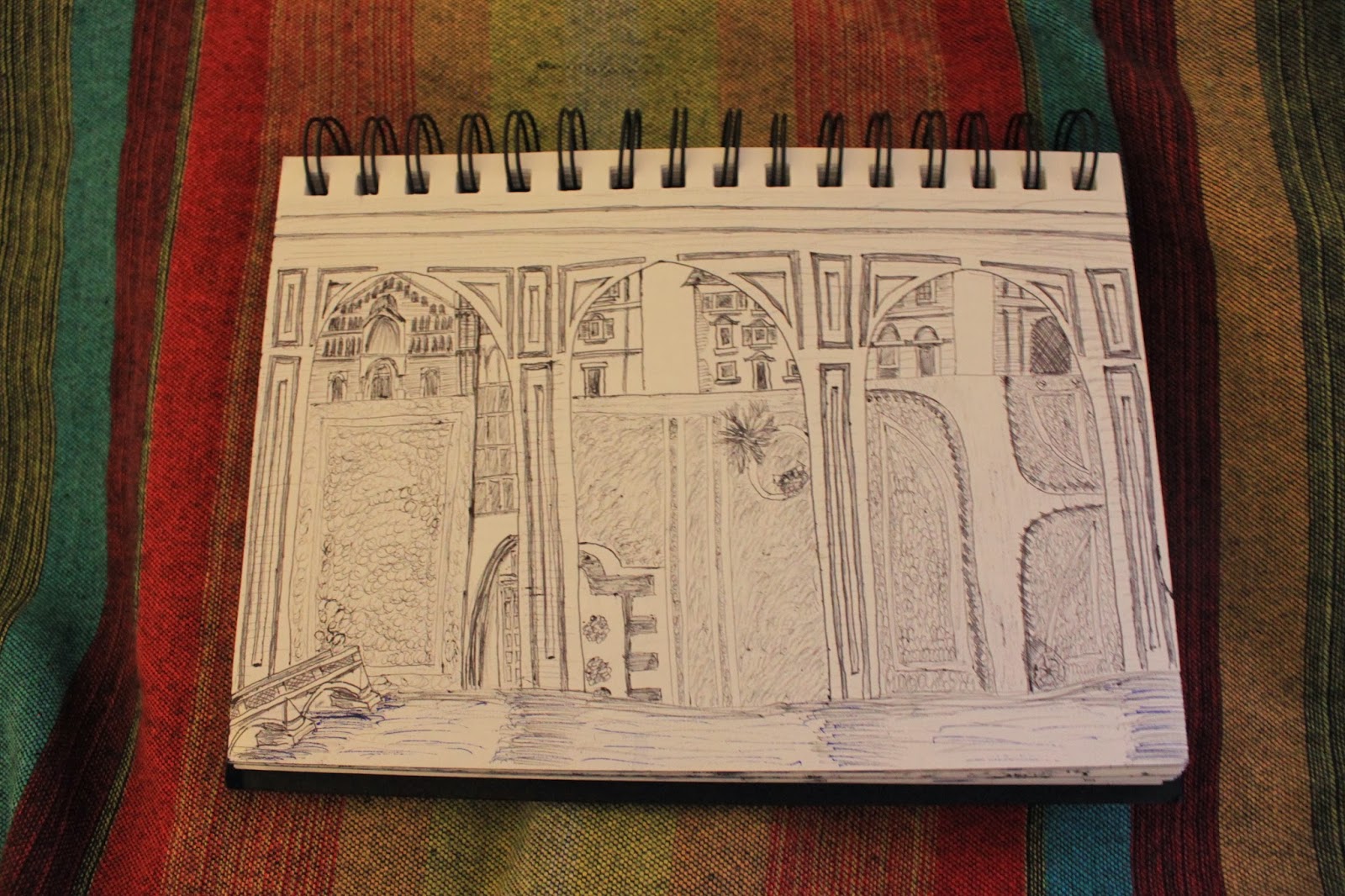
Over the course of our term in Rome, there are two major field trips that everyone looks forward to; the south trip for Rome and the Campagna and the north trip for Italian Urban History. Unlike the south field trip, where every day was fairly relaxing, with lectures during the day, and lounging on the beach in the afternoon and evening, the north trip was intense! The trip was full of switching cities and switching hotels, plus lots and lots of lectures. The lectures were all centered around the idea of the city as a theatre. A place for viewing, and a place to be viewed. During this trip, we also had to do a series of urban armature sketches, that showed the main armature or organizing principle of each city, from gate to gate.
First Stop: Pienza
Pienza was a small medieval town that was rebuilt and repopulated by one of the popes who was born there. The town is surrounded by nature on all sides, giving the people who live there these amazing views of the Tuscan countryside. In the centre of the town, there was a large piazza, with views opening on either side on the church towards the landscape. This square is also one of the brightest spaces in the city, drawing you from the one main road into the light that fills the space.
Urban Armature
The Outer Path of Pienza
The Back of The Piazza in Pienza
Against the Tuscan Landscape
Second Stop: Siena
Siena was the next beautiful town in the north that we visited. This was the second time I can here, having been once already with my family. (And yes, this is where the colour siena comes from, all the bricks in the city are that colour.) Siena was incredibly interesting because of the sqaure at the centre of the city. The square, called "Piazza del Campo" is a sloped piazza, sloping down toward the Palazzo (the cities former government building and current historical museum). This square has an history of horse racing, that continues to this day. Each year (possibly twice a year) each of the 17 districts of Siena choose a horse and rider to race one lap around the piazza. The winner gets bragging rights for a year until the next race is held. The Piazza has 11 entrances and exits that all point you in different directions out into the city. There is also an incredible church in the city called the Duomo, all clad in black and white marble stripes. It kind of looked like the Hamburgeler of churches, but I digress. Siena is a wonderful city that is definitely worth a visit (or two).

Siena Urban Armature
Siena from Above
The Duomo
The Palazzo
Third Stop: Gubbio
Gubbio was an odd third stop. After hours and hours spent on a bus because of torrential rain in Italy washing out part of the highway, we stopped in Gubbio for exactly 30 minutes just as the sun was about to set. Our prof lead the way as we rushed up a series of stairs to a hanging piazza, overlooking the landscape. The view was beautiful, the sky had cleared and the sunset was inspiring. I guess that's why Gubbio was worth a quick stop.
Gubbio Urban Armature
Sunset in Gubbio
Sunset in Gubbio
Fourth Stop: Urbino
Oh Urbino. What to say. Well, you couldn't go anywhere without going uphill. They somehow managed to build that town so that you are always walking uphill! I don't remember going downhill at any point. It was quite odd. The city is built on two peaks of a mini mountain with a main piazza in the valley (I guess I lied about going downhill, but the uphills took so much longer, and thus, get more emphasis).There is not a ton to say about Urbino. It seemed almost as though it was built as a Utopia. Nothing felt out of place there, and the city framed itself at every turn, creating these perfect viewing windows of different areas. No where did this better than the park at the top of one of the peaks. This park was the perfect place to sit and sketch, while appreciating the beauty of the townscape on the other peak. One other interesting thing about Urbino was our accommodation. We had our first ever University living experience! We stayed in dorms and ate cafeteria food. It was exactly as described. Small, cell-like, not exactly clean, and the food was pretty gross, but its cheapness made up for the taste.

Urbino Urban Armature
Urbino First Peak Piazza
View from the Park on the Second Peak
Urbino Through Framed Views
Urbino from the Park at Night
Fifth Stop: Parma
Parma was a city of frames. Frames of history, and literal frames made by the arches present in every single building. Parma, unfortunately, was one of the cities approved to be bombed by the allies in World War II. Luckily, much of the history of the city survived, including the Farnese Theatre. This was the first ever theatre to use a Proscenium. Part of the Palazzo that hosts this theatre was destroyed, but the area left open by it has become a beautiful park, through which people bike and walk to cross the city. The Duomo also survived the war, along with its piazza, forming a historical frame within the city.
Parma Urban Armature
Parma Palazzo
Farnese Theatre
Crossing the River in Parma
A Church in Parma
Wow, this post has gotten long! I will do the other half of the trip in another post sometime soon.
Ciao for now!